The world of high-end manufacturing has never been more complex. Modern factories produce not just physical goods, but also vast amounts of data—from operational logs and supply chain information to customer service records and financial reports. In this environment, AI Agents have emerged as a transformative solution, streamlining backoffice tasks, enhancing customer contact, and leveraging internal data for more intelligent decision-making.
Introduction to AI Agents
Defining AI Agents
AI Agents are autonomous software entities designed to perceive their environment, make decisions, and take actions to achieve specific goals. This goes well beyond traditional rule-based automation; AI Agents learn from past experiences, adapting to new situations and evolving as business needs change. By combining machine learning, natural language processing, and other advanced AI techniques, these agents can handle repetitive tasks, analyze unstructured data, and provide real-time insights—freeing your human workforce for more strategic initiatives.
Why They Matter Now
High-end manufacturing faces growing complexities due to global supply chains, stringent compliance regulations, and skyrocketing customer expectations. Meanwhile, enterprises generate an ever-increasing volume of operational and administrative data. AI Agents are uniquely suited to handle these pressures: they excel at orchestrating and automating workflows, providing immediate support for both customers and employees, and performing rapid data analysis for more informed decision-making. As a result, organizations can reduce operational costs, shorten response times, and remain agile in a fast-paced market.
The Shift Toward Workflow Automation
From Manual Tasks to Intelligent Systems
Historically, manufacturing companies have relied on manual processes or basic software scripts to manage backoffice tasks such as invoicing, email triage, and performance reporting. While these methods may work at smaller scales, they don’t adapt well to fluctuating workloads or more complex data demands. AI Agents tackle these challenges by dynamically analyzing each situation and choosing the best course of action—whether it’s forwarding an invoice for approval, escalating a customer query, or compiling data into a concise executive report.
Key Benefits of Automated Workflows
- Cost and Time Savings
By automating repetitive tasks, organizations can significantly reduce labor costs and increase productivity. Employees can refocus their time on tasks that require human intuition, creativity, or strategic thinking. - Error Reduction
Automated processes minimize the risk of human error. This is vital in quality-critical industries, where a small mistake can lead to large-scale consequences for both safety and profitability. - Scalability
AI Agents easily handle seasonal spikes in workload—such as increased orders or customer support queries—without the need to hire additional temporary staff or invest in excessive infrastructure.
Intelligent Decision Support
Real-Time Insights for Backoffice and Operations
Beyond task automation, AI Agents deliver real-time, data-driven insights that can aid in decision-making. They may analyze historical sales data, current inventory levels, or customer service logs to recommend the best next steps in a process. For example, an AI Agent might detect that a specific supplier consistently causes production delays, prompting you to explore alternative vendors or negotiate better delivery terms.
Augmenting Human Teams
One of the biggest misconceptions about AI Agents is that they exist to replace people. In reality, they serve as “co-pilots,” managing mundane work and surfacing relevant information so that human workers can make better decisions faster. This symbiotic relationship increases job satisfaction for employees—who spend more time on creative, higher-level activities—and dramatically improves organizational efficiency.
Practical Use Cases for AI Agents
Customer Contact & Support
- Automated Email Routing
AI Agents use natural language processing to understand incoming emails, categorize them by topic or priority, and route them to the appropriate department or person. This drastically reduces the backlog of emails that often accumulate in a general inbox, enabling faster, more accurate responses. - LLM-Powered Chatbots
By integrating large language models (LLMs) with a retrieval-augmented knowledge base, chatbots can handle even complex customer queries. They reference current company data—such as product specs, shipping policies, or warranty details—and craft accurate, context-aware answers. This approach lightens the workload for human support teams and ensures consistent, always-on customer service. - AI-Powered Voice Systems
Advanced voice recognition and natural language understanding enable AI Agents to manage phone calls, guide customers through common issues, and even schedule call-backs. This reduces the need for large call center teams, particularly for routine inquiries.
Backoffice Administration
- Order Processing & Invoicing
AI Agents extract order details, check inventory availability, and issue invoices automatically. They can also handle exception cases—like delayed payments or shipment disputes—by flagging them for human review. This speeds up the order-to-cash cycle and reduces human data-entry errors. - Report Generation & Summaries
LLMs can sift through operational data to create concise summaries tailored for different stakeholders. Weekly performance reviews, monthly financial recaps, or even daily quality updates can be auto-generated, ensuring key decision-makers have the information they need without spending hours crunching numbers. - Document Management
Managing technical documents, compliance records, or employee manuals can be tedious and error-prone if done manually. AI Agents integrate with Document Management Systems (DMS) to classify and route these files automatically, maintaining version control and easy accessibility.
LLM-Enhanced Collaboration & Integration
- Cross-Department Communication
AI Agents can scan email threads, chat logs, or meeting transcripts to identify unresolved tasks and key takeaways. They then compile these into a digest or automatically add action items to team workflows, ensuring nothing slips through the cracks. - Knowledge Base Assistance
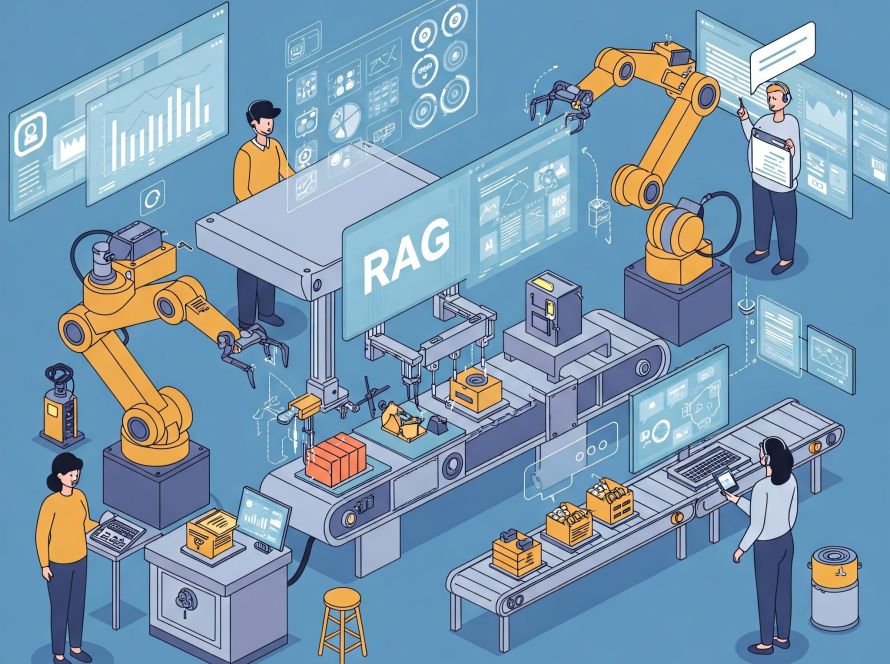
Integrating LLMs with a RAG (Retrieval-Augmented Generation) system allows AI Agents to reference and interpret a wide array of internal business data. Employees—whether in sales, HR, or production—can ask complex questions in natural language and receive immediate, accurate answers from the aggregated knowledge base. - Predictive Maintenance & Logistics (Optional, but powerful)
For manufacturers who want to extend AI capabilities beyond the backoffice, AI Agents can analyze sensor data from the factory floor to detect early signs of equipment failure. They can also optimize logistics routes based on real-time traffic and shipment data, reducing both costs and environmental impact.
Customizable Integration
Seamless ERP, CRM, and MES Integration
Modern organizations rely on multiple systems—ERP (Enterprise Resource Planning), CRM (Customer Relationship Management), and MES (Manufacturing Execution Systems)—to handle everything from supply orders to sales pipelines. AI Agents can serve as a unifying layer, pulling data from these disparate platforms and synchronizing information between them. This ensures consistency across the enterprise and creates a single source of truth for reporting and analytics.
Scalable Architecture
Whether you’re a smaller operation focused on specialized electronic components or a large-scale manufacturer with multiple facilities worldwide, AI Agents can scale with you. They support multiple user groups, additional data sources, and new functionality as your organization grows or pivots to meet emerging market demands.
Security & Compliance
Data security is a significant concern, especially for companies dealing with proprietary designs or sensitive customer information. AI Agents employ encryption, role-based access controls, and ongoing compliance audits to ensure data privacy and protection. This means you can innovate confidently, knowing your IP and customer data are secure.
Conclusion & Next Steps
Embracing the Future of Backoffice Automation
The integration of AI Agents into manufacturing isn’t just an upgrade—it’s a fundamental shift toward greater efficiency, reliability, and insight-driven operation. By streamlining backoffice tasks, enhancing customer contact, and intelligently analyzing your internal data, these agents position your organization to thrive in a competitive marketplace.
Call to Action
- Request a Demo: Interested in seeing AI Agents in action? Schedule a personalized demo to explore how they can be tailored to your existing workflows and data streams.
- Contact Us: Have specific questions or unique challenges? Reach out for a consultation, and discover how AI Agents can help drive your manufacturing processes into the future.
Final Thoughts
AI Agents represent a scalable, future-ready solution to the complexities of modern manufacturing. From automated email routing and intelligent document management to predictive analytics and customer service enhancements, the opportunities for optimization are vast. By embracing these advancements now, manufacturers not only save time and resources but also pave the way for sustained innovation and growth.